![[personal profile]](https://www.dreamwidth.org/img/silk/identity/user.png) eldritchhobbit
eldritchhobbitIn my current trip back through Arthur Conan Doyle's works featuring Sherlock Holmes, I've been thinking of the character trajectories across the stories, especially regarding Holmes's relationship to Lestrade (less celebrated that the brilliant Holmes-Watson partnership, but nonetheless fascinating).
This is more for my benefit than anything else, so I'll put my notes under a cut.
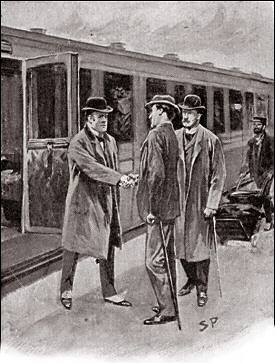
"We All Three Shook Hands" by Sidney Paget, 1902 (Lestrade, Holmes, and Watson)
My thoughts are based on looking at the novels and short stories in internal chronological order (wherever it can be determined), not publication order.
Holmes
Point the First: Arthur Conan Doyle's Sherlock Holmes is quite capable of being obnoxious in the BBC's Sherlock-Cumberbatchian sense. Perhaps one of the worst affronts appears in "The Boscombe Valley Mystery" (set in 1889), in which Holmes plays his "Lestrade's So Stupid That He Wouldn't Understand X" game. The example he chooses, however, 1) is one that Watson doesn't comprehend either and, more to the point, 2) is one predicated on Holmes's own knowledge of Watson's daily grooming habits gained only by the fact he's lived with Watson for years. Of course Lestrade wouldn't reach Holmes's conclusion: he's never lived with Watson, and thus he has no access to that data! The entire exercise is just an excuse for Holmes to show off, not an honest assessment of Lestrade's abilities. Holmes is none too gentle with delivering the insulting conclusion of his reasoning, for that matter, and thus he humiliates Watson. If Lestrade (or Watson) appears to get short-tempered with Holmes now and again, it's not unwarranted.
Point the Second and the More Important: Holmes shows rather compelling character development over the years (and here I'm reminded of the great man/good man point articulated by Lestrade in Sherlock), and it's instructive to watch this unfold through his relationship with Lestrade.[1]
Lestrade
Lestrade is practical throughout -- he bristles at insults and scorns the thought of trusting theorizing over legwork, and yet he proves willing to admit his own mistakes from the very first ("I freely confess that I was of the opinion that Stangerson was concerned in the death of Drebber. This fresh development has shown me that I was completely mistaken..." in A Study in Scarlet, set in 1881) -- but it's clear that the no-nonsense pragmatism of his relations with Holmes grows into genuine warmth and affection over time. Beyond the above examples, there are others.
Random Musings Related to ACD Canon and the BBC's Sherlock
[1] There are other interesting character changes Holmes exhibits, including his evolving thoughts on justice vs. law and means vs. ends, but I'm particularly thinking of his personal, non-Watsonian relationships at present.
[2] It's perhaps worth pointing out that Holmes describes Watson as "not a man with intimate friends" (save, Holmes implies, himself) in The Hound of the Baskervilles.
[3] Interestingly enough, Watson begins referring to Lestrade as "our old friend Lestrade" in works set in 1894 and 1895, including "The Adventure of the Norwood Builder" and "The Adventure of the Bruce-Partington Plans."
This is more for my benefit than anything else, so I'll put my notes under a cut.
My thoughts are based on looking at the novels and short stories in internal chronological order (wherever it can be determined), not publication order.
Holmes
Point the First: Arthur Conan Doyle's Sherlock Holmes is quite capable of being obnoxious in the BBC's Sherlock-Cumberbatchian sense. Perhaps one of the worst affronts appears in "The Boscombe Valley Mystery" (set in 1889), in which Holmes plays his "Lestrade's So Stupid That He Wouldn't Understand X" game. The example he chooses, however, 1) is one that Watson doesn't comprehend either and, more to the point, 2) is one predicated on Holmes's own knowledge of Watson's daily grooming habits gained only by the fact he's lived with Watson for years. Of course Lestrade wouldn't reach Holmes's conclusion: he's never lived with Watson, and thus he has no access to that data! The entire exercise is just an excuse for Holmes to show off, not an honest assessment of Lestrade's abilities. Holmes is none too gentle with delivering the insulting conclusion of his reasoning, for that matter, and thus he humiliates Watson. If Lestrade (or Watson) appears to get short-tempered with Holmes now and again, it's not unwarranted.
Point the Second and the More Important: Holmes shows rather compelling character development over the years (and here I'm reminded of the great man/good man point articulated by Lestrade in Sherlock), and it's instructive to watch this unfold through his relationship with Lestrade.[1]
- In "The Five Orange Pips" (set in 1887), when Watson asks if their unknown visitor might be a friend of Holmes, Holmes replies:
"Except yourself I have none," he answered. "I do not encourage visitors."[2] - Yet in that same year, Holmes's professional familiarity with Lestrade leads him to treat the Inspector not as a guest who requires formal hospitality, but rather as a regular visitor free to consider himself welcome and make himself at home (in "The Adventure of the Noble Bachelor"):
"Good-afternoon, Lestrade! You will find an extra tumbler upon the sideboard, and there are cigars in the box." - In Holmes's letter to Watson in "The Final Problem" (set in 1891), Holmes admits that he has "friends" (plural) who will feel "pain" at his loss.
- In "The Adventure of the Empty House" (set in 1894), Holmes identifies Lestrade -- in front of both Holmes's would-be murderer Colonel Sebastian Moran and, for the very first time, Lestrade himself -- as "my friend Lestrade." (He refers to Lestrade as "friend Lestrade" multiple times thereafter.)[3]
- By "The Adventure of the Six Napoleons" (set in 1900), Holmes regularly welcomes Lestrade's social visits (above and beyond professional meetings about their joint work on a case) with a drop-by-unannounced intimacy usually reserved for one's closest friends and family:
It was no very unusual thing for Mr. Lestrade, of Scotland Yard, to look in upon us of an evening, and his visits were welcome to Sherlock Holmes, for they enabled him to keep in touch with all that was going on at the police headquarters. In return for the news which Lestrade would bring, Holmes was always ready to listen with attention to the details of any case upon which the detective was engaged, and was able occasionally, without any active interference, to give some hint or suggestion drawn from his own vast knowledge and experience.
Lestrade
Lestrade is practical throughout -- he bristles at insults and scorns the thought of trusting theorizing over legwork, and yet he proves willing to admit his own mistakes from the very first ("I freely confess that I was of the opinion that Stangerson was concerned in the death of Drebber. This fresh development has shown me that I was completely mistaken..." in A Study in Scarlet, set in 1881) -- but it's clear that the no-nonsense pragmatism of his relations with Holmes grows into genuine warmth and affection over time. Beyond the above examples, there are others.
- By the time of The Hound of the Baskervilles (probably set in 1888 or 1889, though possibly as late as 1899 or 1900), Holmes is requesting Lestrade's presence ("He is the best of the professionals, I think, and we may need his assistance," Holmes tells Watson), and Watson can see just how their chemistry has matured:
The London express came roaring into the station, and a small, wiry bulldog of a man had sprung from a first-class carriage. We all three shook hands, and I saw at once from the reverential way in which Lestrade gazed at my companion that he had learned a good deal since the days when they had first worked together. I could well remember the scorn which the theories of the reasoner used then to excite in the practical man. - "The Adventure of the Norwood Builder" (set in 1894 or 1895) shows a friendly competition between Holmes and Lestrade in which each teases and mocks the other when the facts seem to fit his theory. (At one point, Holmes admits to Watson, "...upon my soul, I believe for once the fellow is on the right track and we are on the wrong.") But Lestrade is "a practical man," as he admits, and when Holmes ultimately reveals the definitive truth with much added (and arguably unnecessary) drama, Lestrade reacts not with hurt pride or wounded ego, but genuine appreciation. (He also immediately gives credit where credit is due, telling the culprit, "You have done your best to get an innocent man hanged. If it wasn't for this gentleman here, I am not sure that you would not have succeeded.") The physical response from the normally reserved Holmes when Lestrade offers his gratitude speaks volumes:
"... I don't mind saying, in the presence of Dr. Watson, that this is the brightest thing that you have done yet, though it is a mystery to me how you did it. You have saved an innocent man's life, and you have prevented a very grave scandal, which would have ruined my reputation in the Force."
Holmes smiled, and clapped Lestrade upon the shoulder. - And then of course there's the justifiably famous exchange in "The Adventure of the Six Napoleons" (set in 1900):
“Well,” said Lestrade, “I’ve seen you handle a good many cases, Mr. Holmes, but I don’t know that I ever knew a more workmanlike one than that. We’re not jealous of you at Scotland Yard. No, sir, we are very proud of you, and if you come down to-morrow, there’s not a man, from the oldest inspector to the youngest constable, who wouldn’t be glad to shake you by the hand.”
“Thank you!” said Holmes. “Thank you!” and as he turned away, it seemed to me that he was more nearly moved by the softer human emotions than I had ever seen him. - Note: It's no wonder why Holmes might rely on the tenacious Inspector (in addition to his always-worthy Watson) in a situation that has the potential for real danger, such as in The Hound of the Baskervilles. After all, Lestrade proves time and again willing to confront the villains by himself without backup, including Joseph Stangerson in A Study in Scarlet and James Browner in "The Adventure of the Cardboard Box."
For that matter, although he's the slightest man physically in a room of five, Lestrade is the one to bring down the "so powerful and so fierce" Jefferson Hope by "half-strangling" him in A Study in Scarlet. Holmes underscores his trust in the Inspector by calling upon Lestrade once again in "The Adventure of the Empty House," in this case to assist in the capture of the vengeful Colonel Sebastian Moran.
Random Musings Related to ACD Canon and the BBC's Sherlock
- According to my calculations (which I'm happy to explain and be corrected upon), there was approximately a fifteen-year spread between ACD's Sherlock Holmes and Inspector Lestrade, with John Watson and Mycroft Holmes in the middle. If you take the ages of the four male leads in Sherlock, there is a fourteen-year spread between the youngest (Benedict Cumberbatch) and the eldest (Rupert Graves), with Martin Freeman and Mark Gatiss in the middle.
- Also according to my calculations, at the time of ACD's "The Adventure of the Empty House," Sherlock Holmes was 40, John Watson was 41 and nearing 42, Mycroft Holmes was 47, and Inspector Lestrade was approximately 55. As for BBC's Sherlock, which is currently filming the parallel return episode "The Empty Hearse," that puts Martin Freeman and Mark Gatiss at the perfect ages, and Benedict Cumberbatch and Rupert Graves equally four-five years younger than their respective characters.
- I suspect that Sherlock's "Greg Lestrade" isn't short for "Gregory Lestrade," but rather for "Gregson Lestrade." This way, Moffat and Gatiss seamlessly combine Inspectors Lestrade and Gregson, who are identified by ACD's Holmes as, among the Scotland Yard professionals, "the pick of a bad lot. They are both quick and energetic, but conventional — shockingly so." (A Study in Scarlet)
- I wonder if the naming of Sherlock's Molly Hooper is a nod to Molly Robertson-Kirk, a.k.a. "Lady Molly of Scotland Yard" (who was, after all, a contemporary of Sherlock Holmes).
[1] There are other interesting character changes Holmes exhibits, including his evolving thoughts on justice vs. law and means vs. ends, but I'm particularly thinking of his personal, non-Watsonian relationships at present.
[2] It's perhaps worth pointing out that Holmes describes Watson as "not a man with intimate friends" (save, Holmes implies, himself) in The Hound of the Baskervilles.
[3] Interestingly enough, Watson begins referring to Lestrade as "our old friend Lestrade" in works set in 1894 and 1895, including "The Adventure of the Norwood Builder" and "The Adventure of the Bruce-Partington Plans."
![[identity profile]](https://www.dreamwidth.org/img/silk/identity/openid.png)
no subject
Date: 2013-04-20 11:35 pm (UTC)no subject
Date: 2013-04-21 07:11 pm (UTC)no subject
Date: 2013-04-21 03:51 am (UTC)Ah me. Lestrade is by far my favorite of the ACD canon Inspectors (as you probably know), and I find what they've done in the BBC adaptation fascinating. I'm looking forward to see how that Lestrade's character continues to develop in Series 3!
no subject
Date: 2013-04-21 07:37 pm (UTC)I think that you're right that Holmes' growing friendship with Lestrade is a sure sign of Holmes' character development over the course of his career - not just as a detective, but as a person.
I'm so glad to hear that this seems right to you.
You raise a great point about Watson treating Lestrade as a friend, which is so very true. I was fascinated to realize that it's Holmes who first says the "f word" out loud - originally with some wryness, of course, but by the time of "The Empty House" and then many times afterward, with all apparent sincerity and seriousness - and it's only after Holmes says it that Watson uses the term, too (although his actions speak loudly enough before this).
I couldn't agree more that tracing this in Watson, too, tells us important things about his nature, and that his perspective is crucial, because the audience must connect to the story and its major characters through his eyes.
Lestrade was obviously ACD's favorite inspector, as well, considering how often he appears compared to all the others. I love that we get to see him grow older and wiser along with Watson and Holmes.
I find what they've done in the BBC adaptation fascinating. I'm looking forward to see how that Lestrade's character continues to develop in Series 3!
YES! Oh my goodness, YES!!!! *waves hands in the air and bounces* What you said. The trajectory so far has been so beautifully canonical in so many ways (from Sherlock saying he has only one friend, to being willing to sacrifice his reputation and current life for not only John but also Lestrade and Mrs. Hudson) while also being brilliantly original and clever in marvelous ways. I await Series 3 with delight and impatience.
Thank you so much for taking the time to read and reply. I truly appreciate it!
no subject
Date: 2013-04-21 04:17 pm (UTC)no subject
Date: 2013-04-21 07:41 pm (UTC)no subject
Date: 2013-04-21 11:07 pm (UTC)no subject
Date: 2013-04-22 06:58 pm (UTC)Oooh! I hadn't considered A Scintillation of Scions, though it sounds like a fantastic time. I've had one May conference and one June convention already planned for some time, so I hadn't considered anything else, but augh... it does sound wonderful. I need to make notes of all these events for next year. I'm thinking of the annual BSI gathering, too... what else? This ASoS would be particularly convenient... Thanks for the heads up!
Hope your weekend was as wonderful as it was hectic!
no subject
Date: 2013-04-23 07:08 pm (UTC)In Acd the drugs were legal so there is not that component, but there is a friendship in the building, totally different to the relationship Watson and Holmes had in the books, but it is a strong friendship over the years.
I really like Moffat-Gatiss take on Lestrade. In Granada he is more outsider, like their relationship never evolved from him be a recurrant visitor for job.
Also I like the ages are more next to each other with Lestrade, Mycroft, Watson and Holmes. But i wonder why they descide to put Sherlock that younger in the series, because Benedict Cumberbatch is older than his character from the beggining and as Watson being like two year younger than the actor the gap it would be as in the books. But they put a barrier of 5 to 6 years there.
I really hope you can do more meta because this is very interesting.
no subject
Date: 2013-04-24 03:01 pm (UTC)I agree wholeheartedly with your love for the Moffat-Gatiss take on Lestrade (and Rupert Graves's wonderfully subtle and humane performance!) and how the series builds up their acquaintance from the time Sherlock was a drug addict. (You're so right: you just know that Lestrade helped Sherlock in that transition from addiction to consulting work. I can see him succeeding where Mycroft, despite good intentions, would fail.) It was a lovely salute to how much this Lestrade means to this Sherlock that Moriarty would realize the detective inspector was one of the three most important people in Sherlock's life.
I really liked how you contrasted the Sherlock relationship with that in ACD canon (as you say, it's still a strong friendship) and the Granada 'verse. As much as I love the Granada show (such a brilliant Holmes-Watson team!), it never really developed Lestrade and his relationship to Baker Street. Like you point out, he's basically a recurring visitor, an outsider and not much more.
You're right: Benedict Cumberbatch started out as being older than ACD's Sherlock Holmes in the beginning stories (as Martin Freeman was older than Watson), but Moffat-Gatiss condensed many years of cases into a shorter time span, so that now Cumberbatch is younger than his character (but Freeman is the perfect age). It's interesting how that worked out. I think it was worth the added few years between Sherlock's and John's ages to get the incredible chemistry we see between Cumberbatch and Freeman. I also like how the age gap between ACD's Holmes and Lestrade is almost exactly the age gap between Cumberbatch and Graves, even though both actors are now younger than their characters.
Thank you for your encouragement about my meta post and your insights into the story in all of its forms. They're most appreciated!
no subject
Date: 2013-04-24 05:25 pm (UTC)I wanted to differ with you a little as far as the Granada take on Lestrade goes, however. I think the big reason Lestrade's relationship to H&W isn't more developed is that that Colin Jeavons wasn't available for much of the series, not from lack of interest on Granada's part. They did their best to show that Lestrade was a valued member of the team and closer to a friend than just a professional acquaintance, but there just wasn't that much opportunity. SIXN is the episode where they had the best chance; it has many little scenes where they try to show Lestrade's relationship to H and W. For instance, I can't quite see Holmes reacting so emotionally to praise from any of the other yarders as he does to Lestrade in the passage you quote above.
no subject
Date: 2013-04-24 05:49 pm (UTC)As for Granada's Lestrade, I really appreciate your putting him into a clearer context for me. (I'm due for a rewatching of the series, actually, as it's been ages; the box set is out on my coffee table now, waiting and ready!) Most of my general impression wasn't taken from the portrayal itself as much as the lack of regular appearances of the character, and I didn't realize this was due to Colin Jeavons's availability issues rather than an absence of interest on Granada's part. I do recall clearly the "Six Napoleons" scene (and that second, hushed "thank you"), and you're quite right: I can't imagine Holmes being so moved by praise from a mere acquaintance. During my re-watch-athon I'll note more carefully the attention paid when Lestrade is indeed "in the picture," as it were.
I'm most grateful for your insightful comments! Thanks again.
no subject
Date: 2013-04-24 02:28 am (UTC)I like the friendship with Lestrade. While Watson is closer to Holmes in the eccentricities Lestrade seems more like a conventional sort of man. The conventions are part of what make him valuable and a friend to Holmes, someone who doesn't follow his crazy schemes completely and yet can keep up with him all the same.
no subject
Date: 2013-04-24 03:09 pm (UTC)I love your insight here, that Lestrade's very conventionalism makes him valuable to Holmes as a colleague and a friend. What a great point! I enjoy the fact that Lestrade's a practical, no-nonsense kind of person, and yet he's visionary enough to appreciate and accept Holmes on his own terms as the rare and remarkable person he is.
someone who doesn't follow his crazy schemes completely and yet can keep up with him all the same.
Yes! Well said. That's it exactly.
By the way, I just edited this to add a point under the "Lestrade" heading (second bullet down) about "The Norwood Builder," which I forgot to include in the original post. (Fail!!!) I love the image of the normally reserved Holmes smiling and clapping Lestrade on the shoulder when Lestrade concedes the fact Holmes "won" their "competition" about that case: Lestrade's a big enough person not to be jealous or embarrassed, but instead he's genuinely grateful and appreciative for Holmes's assistance, and Holmes seems genuinely moved by Lestrade's reaction.
Thanks again for your comments. I appreciate them!
no subject
Date: 2013-04-25 03:43 pm (UTC)I always love the image of them pulling out tumblers for whiskey or scotch or what-have-you and a shot from the gasogene... cigars puffing, fire blazing... I envy you the experience of a thorough re-reading. Time to get back to it!
G
no subject
Date: 2013-04-27 05:50 pm (UTC)I always love the image of them pulling out tumblers for whiskey or scotch or what-have-you and a shot from the gasogene... cigars puffing, fire blazing...
YES! This! If I had access to a Star Trek-style holodeck, I'd love to recreate 221B and just "sit in" on one of those comfortable evenings of quiet, congenial fellowship.
Thanks again for your thoughts!
no subject
Date: 2013-04-28 02:34 am (UTC)no subject
Date: 2013-04-28 12:28 pm (UTC)no subject
Date: 2013-05-08 08:33 pm (UTC)no subject
Date: 2013-05-08 10:11 pm (UTC)Lestrade's name
Date: 2013-07-05 07:53 am (UTC)Re: Lestrade's name
Date: 2013-08-25 11:21 am (UTC)no subject
Date: 2014-02-23 05:35 pm (UTC)no subject
Date: 2014-04-16 03:37 pm (UTC)yxjds
Date: 2014-04-23 09:35 pm (UTC)tqpab
Date: 2014-04-25 11:55 pm (UTC)